For any brewery to last 40 years is an impressive achievement. To do so in Juneau, Alaska, with no roads in or out, is a monumental one. This year Alaskan Brewing is celebrating its success with another impressive feat — assembling the first ever 40-beer pack that represents both its legacy and the natural beauty of the land its founders call home.
“Most Alaskans are transplants, we come up here for a variety of reasons. For most of us it’s the environment. That informs the beer,” says co-founder Geoff Larson. “People are surfing with sea lions and icebergs. We are living in a place where every day is like a National Geographic image. Many people have had a chance to visit Alaska, we hope we can put a little bit of Alaska in their fridge.”
Alaskan Brewing, then called Chinook Alaskan Brewing, was founded by Marcy and Geoff Larson in 1986 when they were just 28-years-old. It was a daring mission that took 86 investors to open the first brewery in Juneau since prohibition. It could have gone another way, but a fortuitous happenstance of discovery is credited for their early and ongoing success.
While researching Alaska beer history, Marcy stumbled upon an article about Gold Rush-era Juneau brewery Douglas City Brewing Co. (1899-1907) that featured an interview with the brewmaster who described their flagship beer — an amber ale made with imported Czech hops.
“At the same time, I think three days later, a collector called us and said ‘hey I got all this stuff from this brewery’ and it happened to be the same brewery,” says Marcy.
They set off trying to recreate the recipe.
“Basically we reverse engineered from the raw materials they ordered,” says Geoff, who was a chemical engineer and homebrewer at the time. “The insight from that interview with the brewmaster and all the challenges he faced was that it was a very cold time in Juneau. The glaciers were quite a bit closer to town, there were icebergs actually in the downtown harbor. So he had quite a hard time keeping things warm.”
Similar to the Altbiers of Dusseldorf, Germany, the challenge became finding an ale yeast that could ferment at a cold temperature. Alaskan Brewing’s first 16 or so batches with various yeast strains had to be dumped because they fizzled out with too much residual sugar and sweetness. They eventually found the right strain.
“We needed it to be repeatable,” says Geoff. “Finding the right yeast, hops and malts really give the impression of the 100-year-old recipe we were trying to replicate.”
That beer became the now iconic Alaskan Amber Ale, the brewery’s first beer and still the flagship after all these years.
Still, finding an audience in a small city surrounded by water, glaciers and fishermen, who had never even heard of a microbrew wasn’t easy.
“This was 40 years ago. The craft movement had just begun in many ways. I think people were surprised by that type of flavor experience. That was a big departure in the beer flavor from what was available then,” says Geoff.
Early on the brewery would recruit local volunteers to help package and bottle their beers.
“The rejects that were high or low fills would be divvied up between those of us on the line,” remembers Marcy. “We had quite a number of fishermen that were helping us out and sure enough a number of our packages ended up down on the docks and other fishermen got into it, and pretty soon we were a beer that was definitely enjoyed and appreciated by the fishing fleet.
“I remember a fisherman coming up to me and saying ‘You are killing me! You are killing me,’” Marcy recalls. “I said ‘why?’ and he said ‘this beer is amazing!’ I said ‘why is that killing you?’ and he said ‘because I can’t drink Rainier anymore!’ ”
Alaskan Brewing CEO Max Rule adds to the story. “If you fast forward to today where we have distribution to 24 states — all of our 150 relationships with distributors,” he says. “But in those early days our beer got down to Seattle in Rainier’s backyard. And how did our beer get down to Seattle? It was the fishermen!”
In 1995, Alaskan Brewing upgraded from a 10-barrel system to a new 100-barrel brewhouse, making it one of the largest craft breweries in the nation.
Being so far away from energy resources also taught them to become self-sustainable and a leader in green energy initiatives. In 1998, Alaskan Brewing became the first craft brewery to operate a C02 recovery system. Then in 2008, Alaskan Brewing became one of the first craft breweries to install a mash filter press, saving more than a million gallons of water per year.
“We have no roads in, no roads out, everything has to come from Seattle — about five days by sea barge,” says Curtis Holmes, Alaskan Brewing’s plant manager. “So part of what pushed our C02 story is that it would take a week to get C02 here, but in the worst case we would lose half of the CO2 because it would warm up and off-gas on the trip up.”
At first the brewery was on the rural edge of a town, but the city eventually grew around them. In the early days they had a lot of concerns about wildlife.
“We had some real concerns about attracting bears. I was really worried about all that malt coming out after brewing that was so aromatic, so then we put up a fence around the building and a bear still got in but it couldn’t get out!” says Geoff with a laugh.
This led to them becoming the first craft brewery to install a Biomass Steam Boiler which formed their first process patent for “Beer Powered Beer” in 2016.
“Our spent grain used to be taken to a community garden when we were on a 10-barrel system, but once we stepped up to a bigger brewing system we would have as much in a day as we used to have in a month and they couldn’t deal with it,” says Holmes. “Juneau has no farming or agriculture of any kind, so it was like now we have to do something different to get the grain out of here. So it led to our biomass boiler and now we are able to use the grain here as a fuel.”
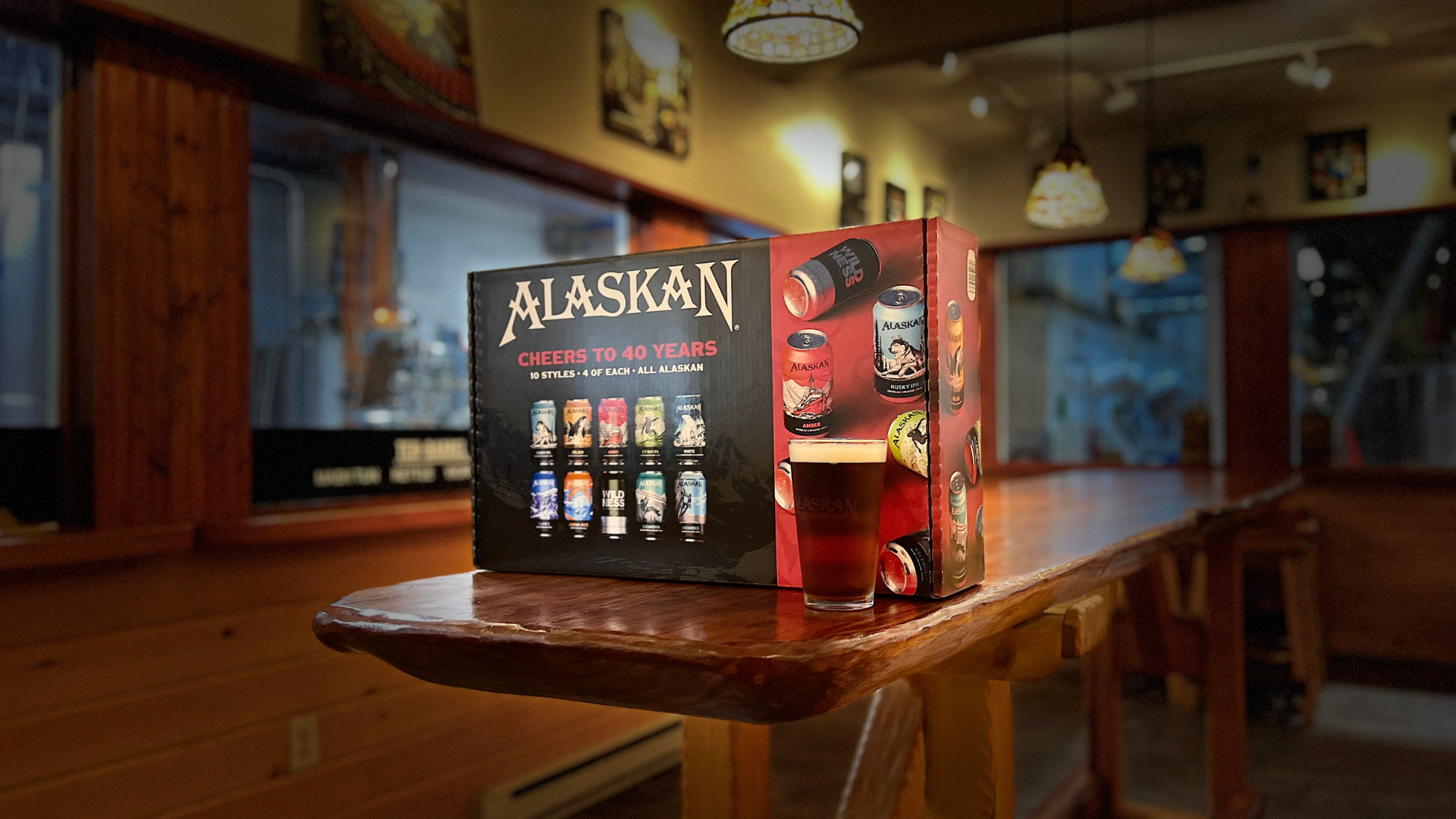
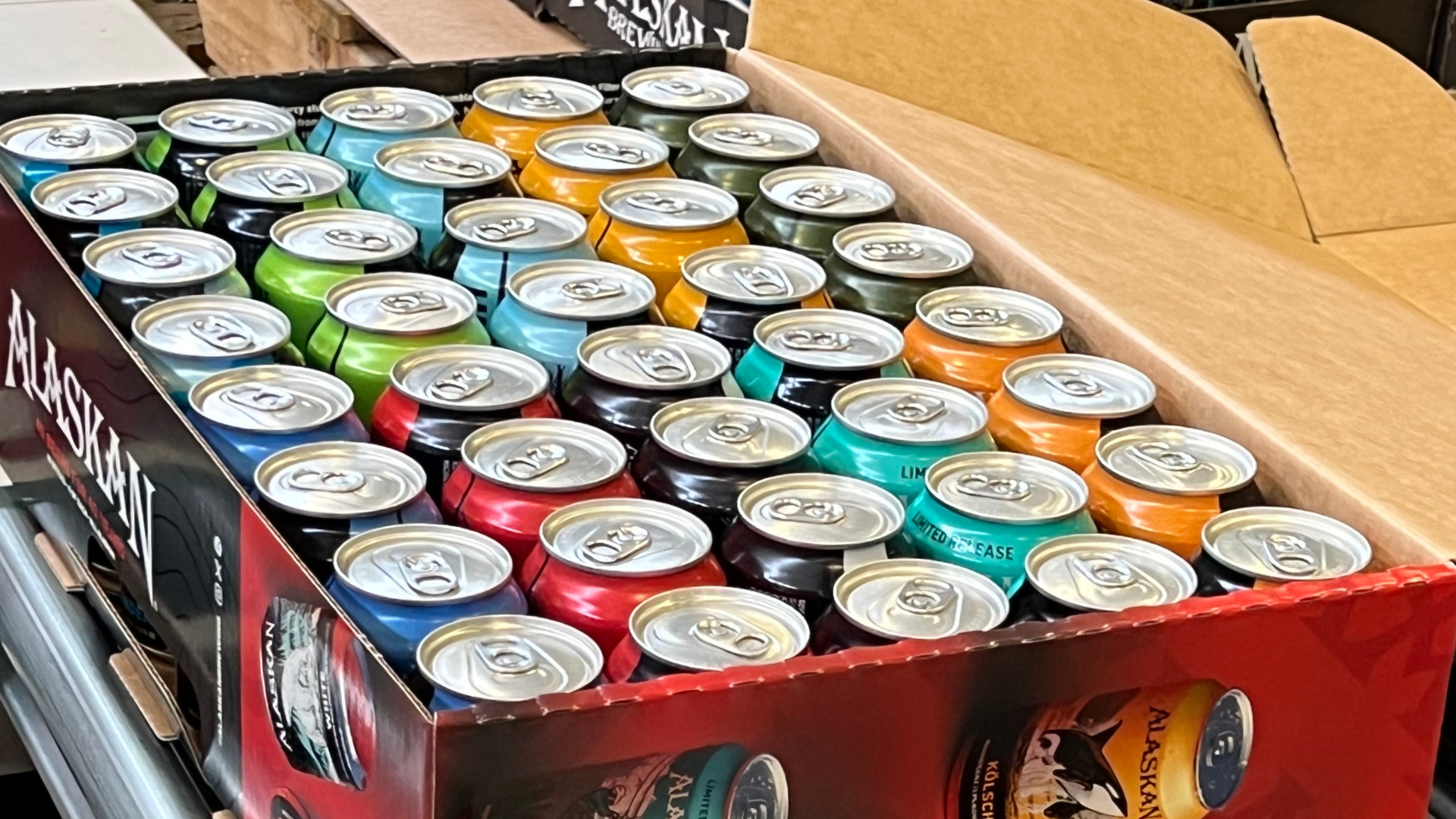
With their anniversary approaching in 2026, the question arose on how to best celebrate a 40-year milestone. Someone came up with the crazy idea of creating a 40-pack, but not just of 40 cans but of 10 different beers that represented the full breadth of the brewery’s current portfolio.
“It was one of those projects that was so out of this world it seemed ridiculous. But it was like ‘yeah that will be fun, let’s figure it out,’” says Dave Martin, Alaskan Brewing’s productions operations manager who took lead on the project.
“I gathered up all of the production managers, our brewing manager, our marketing manager, our packaging manager, quality assurance, etc., we all just sat in a room and didn’t know where to start. We just spitballed. At first it was like ‘that’s stupid’ and ‘no, that’s stupid!’ it got a little spicy,” recalls Martin. “Thesis. Antithesis. Synthesis. All these ideas came together and the breakthrough was ‘oh we have permission to buy new conveyors?’”
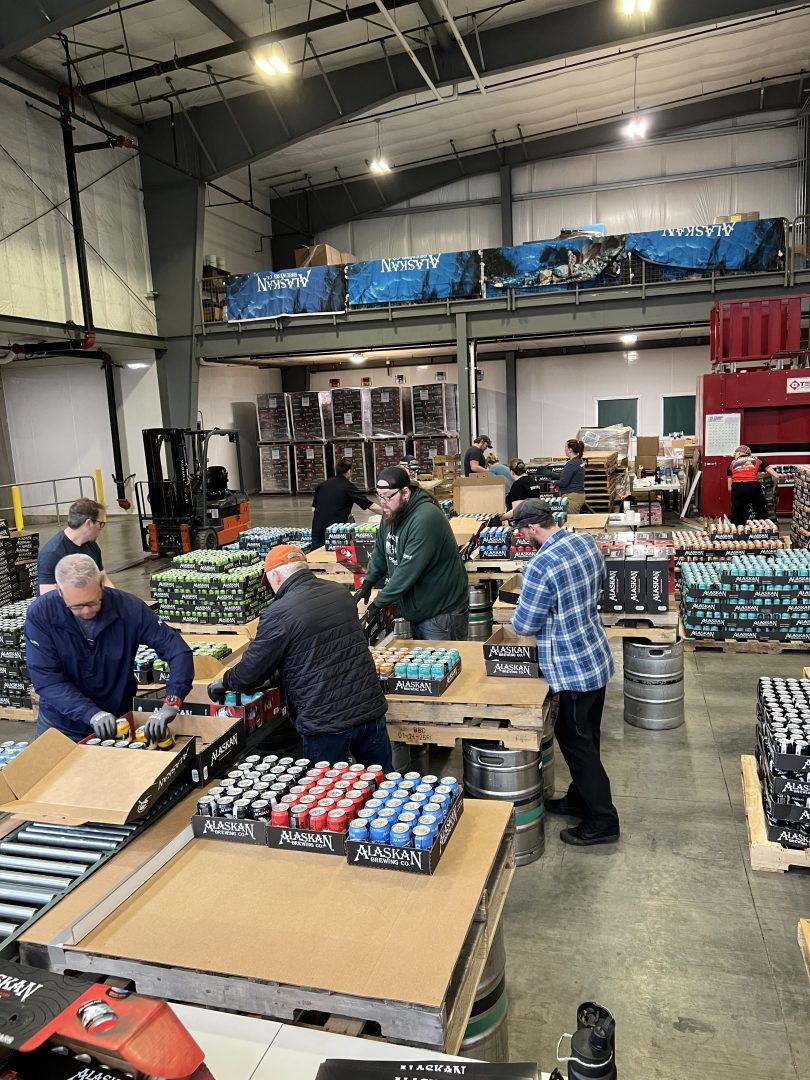
They had to make 10,000 of these, so every second was counting in the time that it would take to assemble such a large project that would require 16 employees and conveyors that could run both directions to double their speed.

“It was all hands on deck. Everything was packed by hand, it was sealed by hand, palletizing and building 10,000 boxes by hand. I still have scars on my wrists from building boxes,” says Martin. They gathered a team that included people from accounting, marketing, quality assurance, warehouse, and the C-suite. “We had a window of time that the brewery could focus on these 40-packs without the other operation suffering, so that was why 10,000 of these were our peak without interfering with other operations.”
The 40-Pack includes 4-cans each of the iconic Alaskan Amber, Husky IPA, Kölsch, Icy Bay IPA, White Ale, Class 5 Pale Ale, Juneau Juice IPA, Excursion West Coast IPA, Ascender Pale Ale and Wildness.
“It’s an introduction or reintroduction to Alaskan Brewing,” adds Geoff. “Our 40-pack is all about innovation and who we are. In the Lower 48 our Alaskan Amber Ale is what we are known for, but here in Alaska we are always innovating.”
Although they now brew on a 100-barrel system, Alaskan Brewing still uses their original 10-barrel brewhouse for pilot brews, and even have a 1-barrel system where any member of the staff can sign up to create their own recipe and maybe one of them may eventually get scaled up and become part of the legacy in a 50-pack 10 years from now.
“There was a sense of camaraderie and pride. To handpack 400,000 cans by hand and have everyone come back and come together to produce this for the market was really something. We are really proud, says CEO Max Rule.
“That pack is an example of ‘here is what built us’ and here is what we can do,” adds Martin.
Find a 40-pack beer near you here.